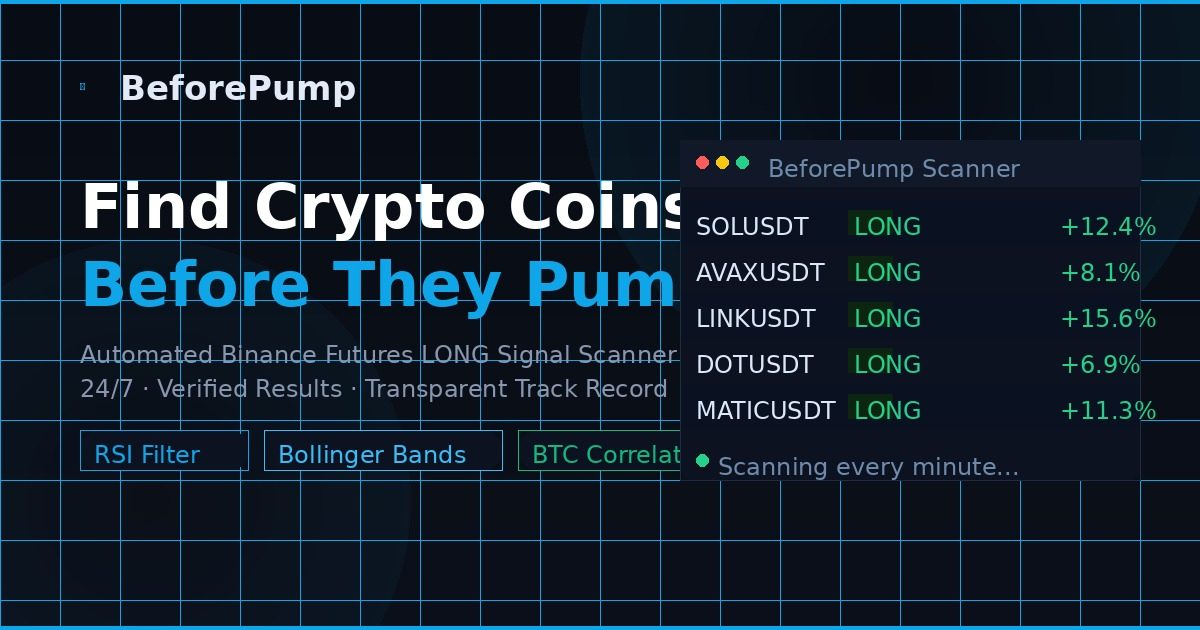
Most crypto signal services flood you with noise — 30, 50, even 100 alerts per day, so you can never tell which to act on and which to ignore. High-quality daily crypto signals come from automated scanners that apply consistent criteria, not human tipsters running paid Telegram groups. Here's how to tell the difference, and how to build a trading routine around signals that are actually worth acting on.
What Makes a Good Daily Crypto Signal? (5 Criteria)
The daily crypto signal landscape is full of services ranging from legitimate automated tools to outright scams. Before you subscribe to anything, evaluate any signal service against these five criteria:
1. Clear Entry Price — Not Zones
A high-quality signal gives you a specific entry price, not a vague range like "buy between $2.10–$2.40". Automated scanner signals fire at the exact moment conditions align, so the entry is always a precise market price at the time of the alert. Vague zones are a hallmark of manually-written tipster signals — they allow the signal provider to retroactively claim they were right regardless of where you entered.
2. Stop Loss Defined
Every legitimate daily crypto signal includes a stop-loss level. If a service sends entry alerts with no stop-loss guidance, it's prioritising the appearance of winning trades over your risk management. On Binance Futures, a position without a stop loss can liquidate entirely on a routine adverse move. A service that omits stop-loss data is not a trading tool — it's entertainment. Read our complete LONG signals guide for proper stop-loss placement methodology.
3. Verifiable Win Rate History
Any signal service worth using publishes its historical signal results publicly, including losses. Promises of "90% win rate!" without a publicly auditable signal history are a red flag. BeforePump publishes every signal result at the track record page — open to anyone, no subscription required. Check whether the count of wins and losses matches the stated win rate before you spend a dollar.
4. Disclosed Data Source
Know what is generating the signal. Automated scanner signals disclose their methodology — the type of data they draw on and the timeframes they cover. Human tipsters rarely do. BeforePump's scanner evaluates a composite, multi-factor model across every Binance Futures altcoin simultaneously and surfaces a strength score for each. That transparency lets you evaluate signal logic, not just results. For a deep explanation of how the scanner works, see how BeforePump works.
5. No Fakeout Setups
A good signal service avoids environments where its signals are statistically likely to fail. BeforePump's scanner filters out high funding-rate environments (overcrowded longs = cascade liquidation risk) and unstable BTC conditions (falling BTC drags all altcoins). The signal quality gate means fewer signals on bad days — and that's a feature, not a bug. For the full accuracy data, see our crypto scanner accuracy test.
The Problem with Free Telegram Signal Groups
Free Telegram crypto signal groups are the most common source of daily signals for new traders — and the most dangerous. The problem isn't that they're always wrong. It's that you cannot evaluate whether they're right for the right reasons. Here's the honest comparison:
| Criterion | Free Telegram Groups | BeforePump Automated Scanner |
|---|---|---|
| Signal source | Human — subjective, inconsistent | Automated scanner — fixed criteria |
| Track record | Rarely published — or cherry-picked | Full public record including losses |
| Signals per day | Arbitrary — usually far too many | 3–10 quality-gated signals |
| Stop loss | Missing in many groups | Included in every alert |
| Methodology transparency | None — "trust us" | Full methodology documented publicly |
| Market filters | No filters — fire in any conditions | BTC + funding rate + OI filters |
| Execution window | Often vague or already stale | Precise entry with timestamp |
Looking for a transparent alternative? BeforePump's free crypto signals guide explains what a legitimate free signal looks like and where to find verifiable ones.
How BeforePump Delivers Daily Signals
BeforePump's automated scanner runs 24/7 across the full range of Binance Futures altcoin perpetual contracts, firing LONG signals when its multi-factor model aligns. Here's what each daily signal contains:
- Coin ticker — the exact Binance Futures perpetual contract (e.g., SUIUSDT, ORDIUSDT, TIAUSDT)
- Entry price — the market price at the exact moment the signal fires
- Current market context — a snapshot of the conditions the scanner detected around the setup
- Strength score — composite score from 0–100 reflecting how strongly the scanner's multi-factor model has aligned
Typical daily volume: 3–10 signals per day on normal market conditions, varying with BTC momentum and overall altcoin market structure. The scanner quality-gates signals — on days when BTC is unstable or funding rates are elevated across the board, signal count drops naturally. Fewer signals on bad days is by design.
Want to understand what the scanner is actually measuring? See our full breakdown of how the automated scanner works in how BeforePump works, or explore per-coin scores in the subscriber-only crypto pump scanner. For context on why accuracy matters more than volume, read the best crypto signal provider evaluation guide.
Daily Signal Example
Here is what three consecutive BeforePump daily signals look like in the Telegram channel. All values are from the exact moment each signal fired:
Each signal gives you everything needed to evaluate and act in under 60 seconds: coin, exact entry, OI momentum, volume confirmation, funding environment, composite strength, and stop-loss level. The strength score reflects how cleanly the scanner's multi-factor model aligned — scores above 80 represent the highest-conviction setups.
How to Use Daily Signals in Your Routine (5-Step Morning Routine)
Building a consistent routine around daily crypto signals is what separates traders who use signals profitably from those who react randomly to every alert. Here is a practical 5-step morning framework you can implement immediately:
-
1
Check BTC conditions first (2 min)
Before reviewing any signal, open BeforePump's BTC analysis page. Is BTC trending up or sideways on the 4H? Is it in active downtrend or high volatility? If BTC is in freefall or making volatile swings, skip the session entirely. Altcoin signals fired in a bearish BTC environment have a significantly lower hit rate regardless of signal strength score. -
2
Review overnight signals for freshness (3 min)
Open Telegram and scan the last 12 hours of signals. Signals older than 30–60 minutes need a price check. If the coin has already moved more than 3–4% above the signal entry, the ideal risk/reward window has closed — do not chase. Mark any signals within 30 minutes old as candidates. -
3
Score your candidates by strength and OI (2 min)
From your fresh-signal candidates, prioritise by strength score (highest first) and OI change (positive, not decreasing). A signal with an 87+ strength score and +12% OI change in the last hour is your primary candidate. A 71 strength score with flat OI is secondary — act on it only if your primary is already moving. -
4
Check the coin's funding rate in real time (1 min)
On Binance Futures, check the current funding rate for your candidate coin. If it has risen significantly above the value stated in the signal (e.g., from +0.004% to +0.025%), the market has become more crowded since the signal fired — reduce position size or skip. Stable or lower funding since signal fire = conditions unchanged, proceed normally. -
5
Execute with pre-set stop and TP — then walk away (5 min)
Open Binance Futures, enter at market or limit close to signal entry. Set stop loss immediately (do not skip). Set take-profit levels at +5%, +10%, +15% — consider closing 50% at +5% to lock profit, letting the rest run with a trailing stop. Do not move your stop loss wider after entry. Once the order is placed, close the tab and let the trade work. Check again at the next session. Full execution walkthrough: Binance Futures LONG signals guide.
Daily Signal Checklist: What to Verify Before Acting
Use this checklist before acting on any daily crypto signal — from BeforePump or any other source. Skip any item at your own risk:
- Signal is under 30 minutes old — or price has not moved more than 3% from signal entry
- BTC is stable or trending up — check Bitcoin Analysis right now, not when you woke up
- OI change is positive — new money entering the market, not exiting
- Volume multiple is at least 2× — confirms genuine buying activity, not low-liquidity drift
- Funding rate is below +0.02% — market not overcrowded on the long side
- Strength score is 75 or above — below 75 means partial factor alignment; higher risk
- You know your stop loss BEFORE entering — never enter a Binance Futures position without a predetermined stop
- Position size is appropriate — never more than 2–3% of account per trade at 3–5× leverage
For independent accuracy data, see our crypto scanner accuracy test, which walks through historical signal performance by market condition. For the methodology behind what makes BeforePump different from generic signal providers, read the best crypto signal provider guide.
❓ Frequently Asked Questions
⚡ Start Receiving BeforePump Daily Signals
Subscribe to get 3–10 high-quality daily signals on Binance Futures altcoins delivered instantly via Telegram — with entry price, current market context, and a composite strength score in every alert. Or try a free signal first.
