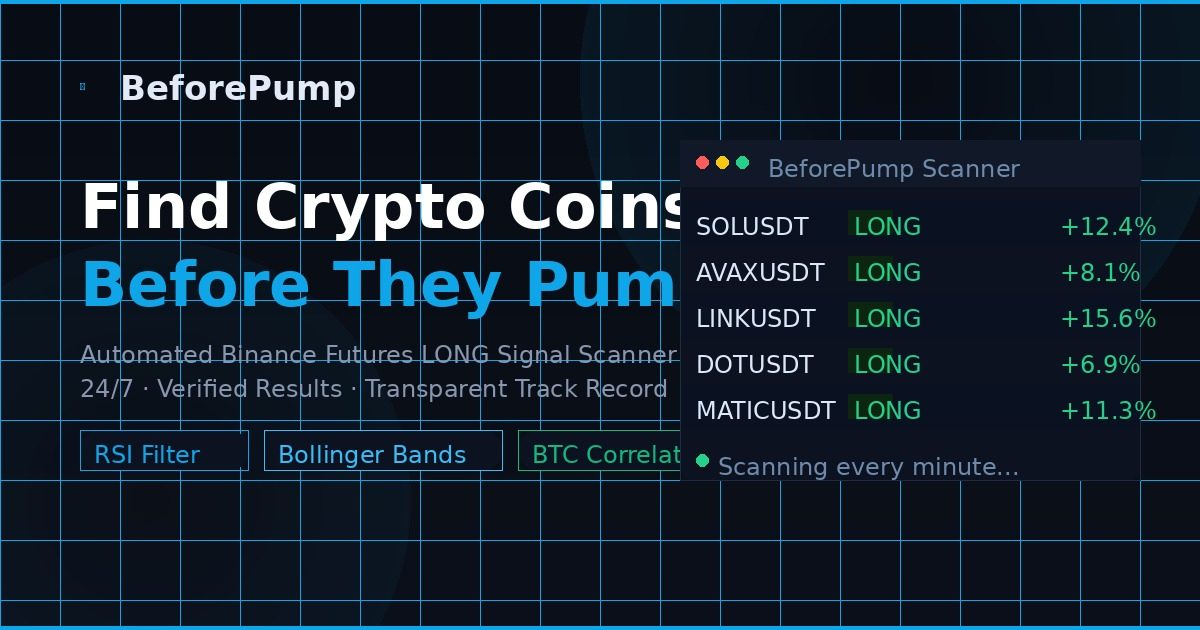
Every 10 seconds, the BeforePump scanner sweeps the full Binance Futures market, asking a single question: has a confluence of conditions emerged that historically precedes a price pump? This is what a crypto pump detector does — and in a market where 700+ altcoins trade simultaneously, 24 hours a day, it's the only systematic way to catch early breakout setups before the crowd notices them.
Whether you're new to crypto futures or looking to replace your manual scanning routine with something that actually scales, this guide explains exactly how a crypto pump detector works, what data it analyzes, and how to use BeforePump's free crypto signal to see it in action — no subscription required.
What Is a Crypto Pump Detector?
A crypto pump detector is automated software that continuously monitors cryptocurrency markets — especially Binance Futures perpetual contracts — analyzing technical indicators and market structure across dozens or hundreds of coins simultaneously. When a multi-factor model combining momentum, volatility, volume and market-positioning signals aligns, it fires a LONG signal alert.
Unlike a trading bot that executes positions automatically, a pump detector is a signal tool: it identifies when conditions are favorable for a price move and notifies you. You remain in control of whether to act, how much leverage to use, and where to set your stop loss. This distinction matters enormously for risk management.
BeforePump's scanner monitors the full Binance Futures market simultaneously, around the clock. Each coin is evaluated on a multi-factor scoring model every few seconds. When any coin crosses the signal threshold, an alert fires — including coin name, entry price, and current BTC conditions — delivered via Telegram. Subscribers also get the live crypto pump scanner.
Want to see what a signal looks like in practice? Try our free pump detector now — the latest signal is always visible with no account required.
How Does a Crypto Pump Detector Work?
The technical pipeline of a pump detector follows a consistent pattern: pull real-time data → score each coin against multiple factors → fire an alert when the composite score crosses a threshold. Here's how BeforePump implements each stage.
Stage 1 — Real-time data ingestion. The scanner pulls OHLCV data (Open, High, Low, Close, Volume) directly from exchange APIs at the latest candle resolution. On Binance Futures, this means live 1-minute, 15-minute, 1-hour, and 4-hour candle data refreshed continuously across all monitored coins.
Stage 2 — Multi-factor scoring every few seconds. Each coin is run through a multi-factor model combining momentum, volatility, volume and market-positioning signals simultaneously. Partial scores are tracked and, for subscribers, shown in the coin scanner as "pump-readiness scores" — so you can see which coins are approaching signal conditions before the alert fires.
Stage 3 — Signal threshold crossing. When a coin's composite score crosses the configured threshold — meaning the multi-factor model aligns — the scanner fires a LONG signal. Partial alignment doesn't trigger a signal; the system waits for the full confluence.
The multi-factor model draws on several independent families of signals:
Macro alignment is the gatekeeper. Altcoins move in strong correlation with Bitcoin, especially on Binance Futures where the entire market is interconnected through leveraged positions. A falling BTC will drag even the most technically compelling altcoin setup into a loss. The scanner weighs the broader market environment before allowing any signal to fire. Check current BTC conditions at the live Bitcoin analysis dashboard.
Volatility compression identifies the phase that precedes breakouts. Extended low-volatility periods in crypto futures markets almost always resolve as sharp, fast expansions. By flagging coins where volatility has compressed to historically low levels, the scanner positions you ahead of the expansion — not after it's already begun. For a deeper breakdown of how RSI works alongside volatility setups, see our guide on BTC RSI divergence explained.
The crowding filter screens out setups that look technically strong but carry hidden risk. When the long side of the market is overcrowded and heavily leveraged, any downward move can trigger cascading liquidations. The scanner avoids these conditions, preferring cleaner positioning where the entry environment is healthier. For a full explanation of how funding rates work, read our complete funding rate guide.
Momentum tracks alignment across multiple timeframes simultaneously. The signal looks for early shifts on shorter timeframes beginning to recover while the higher timeframes haven't yet confirmed the move. This early-timeframe alignment is what allows the scanner to alert before the price move is obvious to most traders. For the complete breakdown of how LONG signals work, see the complete LONG signals guide.
What Data Does a Pump Detector Analyze?
A crypto pump detector's signal quality is directly tied to the breadth and freshness of the data it ingests. Here's what BeforePump's scanner analyzes for every coin, every cycle:
- OHLCV price data — Open, High, Low, Close, and Volume across 1m, 15m, 1H, and 4H candles. The foundational input for all indicator calculations. Sourced directly from Binance Futures API in real time.
- Bollinger Band Width (BBW) — Derived from the 20-period Bollinger Bands. The key squeeze detection metric: when BBW drops below a coin-specific historical threshold, volatility compression is confirmed.
- RSI across timeframes — Calculated independently on 15m, 1H, and 4H charts. Multi-timeframe alignment — not a single timeframe reading — is what drives the momentum component of the score.
- Funding rate — The 8-hourly perpetual contract funding rate for each coin on Binance Futures. Both the current rate and the trend direction matter. See our funding rate guide for how to interpret each range.
- BTC price direction — The scanner evaluates Bitcoin's 4H price trend and recent volatility as a macro filter. A falling or highly volatile BTC environment can veto an otherwise high-scoring coin setup. Monitor it live at Bitcoin Analysis.
- Volume momentum — Rising volume during a Bollinger squeeze, before the actual breakout candle, is a leading indicator of genuine buying accumulation rather than low-liquidity drift.
- Open interest trends — Increasing open interest during compression (new money entering) combined with neutral funding signals organic positioning — a healthier base for a sustained move than a leverage-driven spike.
The combination of these data streams — applied to the full market continuously — is what makes an automated pump detector qualitatively different from a human scanning the same charts manually. No single trader can maintain awareness of this many metrics across hundreds of coins simultaneously. The scanner can, and does, continuously.
Crypto Pump Detection: How the Main Methods Compare
Crypto pump detection is not one technique — it's a family of approaches, and they differ enormously in how early they fire and how trustworthy they are. If you're comparing tools (or Telegram channels promising "binance pump signals"), this is the honest map of the landscape:
| Detection method | When it fires | Main weakness |
|---|---|---|
| Volume-spike alerts | After the move has started | Reactive — by the time volume spikes, the best entry is usually gone |
| Social / trending monitors | Late — once a coin is already hyped | Measures attention, not market structure; crowded entries |
| Order-book watchers | Seconds-to-minutes ahead | Spoofed walls and pulled orders create constant false positives |
| "Big pump signal" Telegram groups | The organizers decide when | Coordinated manipulation — members ARE the exit liquidity. Avoid |
| Multi-factor pre-breakout scanners | During compression, before the move | Probabilistic — flags conditions, not guarantees; some signals fail |
The critical distinction is the last two rows. Coordinated "pump groups" are not detection at all — they manufacture the pump and profit from members who buy late. If a channel tells you which coin will pump at what time, you are the product. We break down how these schemes work (and how to spot them) in our guide to detecting crypto pump-and-dump schemes.
Data-driven detection — the approach BeforePump takes — reads public market structure instead: volatility compression, volume accumulation, positioning, and BTC-independence. It fires during the build-up phase, and because it's probabilistic, an honest provider shows you the full outcome history. Ours is public at the track record page, wins and losses alike. Comparing providers? See what to demand from any signal service in our guide to the best crypto signals on Telegram.
Manual Detection vs Automated Pump Scanner
Many traders start their crypto journey scanning charts manually. It works — until you realize the math doesn't scale. Here's the honest comparison:
| Manual Detection | Automated Scanner | |
|---|---|---|
| Coins monitored | Realistically 3–5 at a time | Full market simultaneously |
| Refresh speed | Minutes per coin | Every few seconds |
| Emotional bias | High — recency bias, FOMO | None — purely data-driven |
| Works while you sleep | No | Yes, 24/7 |
| Consistency | Depends on your focus and mood | Same criteria every cycle |
| Early detection | Often after the move starts | During pre-breakout compression |
Manual scanning is how most traders start — and how most miss the best setups. When you're watching SOLUSDT, the Bollinger squeeze on AVAXUSDT completes, breaks out, and runs 12% in 2 hours while you weren't looking. In a market where over 700 Binance Futures coins trade simultaneously across 24-hour sessions, automation is no longer optional. It's the baseline.
Subscribers get BeforePump's live coin scanner, which shows pump-readiness scores for all monitored coins — even between signal fires — so you can see which coins are building toward signal conditions right now.
How to Use BeforePump's Free Pump Detector
You don't need a subscription to see BeforePump's scanner in action. Here's how to use the free version right now:
-
1Visit the free crypto signal page and see the latest signal — including coin, entry price, pump-readiness score, and the BTC conditions at the time the signal fired. No account or signup required.
-
2Check BTC conditions at Bitcoin Analysis. Confirm BTC is stable or trending upward. If BTC is in active sell-off, even a strong signal carries elevated macro risk — wait for stabilization.
-
3Evaluate signal freshness. If the signal is under 30 minutes old and BTC is stable, the trade window is still open. If more than 30 minutes have passed, check whether the coin's price has already moved more than 3–4% above the signal entry. If it has, skip this signal.
-
4Use the execution guide for the step-by-step walkthrough: how to open the position on Binance Futures, set leverage, place your stop loss, and configure take profit levels correctly.
Ready to receive every signal the moment it fires — directly to Telegram with no page-refreshing required? Subscribe now to get full scanner access and real-time Telegram alerts. Or get a free signal first to see the format and quality before committing.
After the Signal Fires — What to Do
Receiving a pump detector signal is the starting point, not the finish line. How you act on it determines the outcome. Here's the correct sequence:
- Verify freshness first. Check the signal timestamp. Under 30 minutes is ideal. Over 30 minutes, check how much the price has moved since the signal entry — if it's already up 3–4%, the ideal risk/reward window has closed.
- Check BTC right now. Even if BTC was stable when the signal fired, conditions can change. A fresh BTC sell-off in the last few minutes changes the equation. Confirm current BTC direction at Bitcoin Analysis.
- Enter on Binance Futures with appropriate leverage. 3x–5x is the recommended range for signal-based trading. Higher leverage reduces your liquidation distance to dangerous levels on a volatile altcoin.
- Set a stop loss immediately. Before closing the browser tab, place your stop 3–5% below entry. This is non-negotiable — futures positions without stop losses can liquidate fully during a routine adverse move.
- Set your take profit. Most BeforePump signals target 5–15% moves. Consider closing half the position at 5% and trailing the remainder with a moving stop.
For detailed screenshots and the full step-by-step execution walkthrough, visit the BeforePump how-to-use guide. To verify historical signal performance before trading, review the complete results at the track record page — every signal, every outcome, including losses.
We Build Custom Pump Detectors
Not every trader fits a one-size-fits-all scanner. Some strategies require specific indicator combinations — different RSI periods, custom Bollinger Band lengths, or signals filtered by open interest thresholds. Others need coverage of coin subsets outside Binance Futures, such as spot markets, specific DeFi tokens, or different exchange APIs entirely.
BeforePump builds custom scanning tools for traders who need configurations that go beyond the standard scanner. This includes:
- Custom indicator sets — different timeframes, modified RSI lookback periods, alternative volatility measures
- Specific coin subsets — focus only on top 50 by open interest, specific sectors, or custom coin lists
- Custom score thresholds — tighter or looser signal conditions depending on your strategy's risk tolerance
- Telegram integration — custom bots that fire alerts to your private channel or group
- Full system integration — scanner output connected to your existing trading infrastructure
If you need a scanning tool built around your exact strategy parameters, contact us to build a custom pump detector. We'll discuss your requirements, assess feasibility, and provide a clear timeline. You can also discuss your custom scanner requirements with our team directly — no generic template responses.
❓ Frequently Asked Questions
⚡ Start with BeforePump's Pump Detector
Subscribe to receive LONG signals via Telegram the moment they fire — with entry price, coin name, and live market conditions. Or try a free signal right now with no subscription required.
